Political Turmoil in Reconstruction-era Texas
News of the WorldPolitical Turmoil in Reconstruction-era Texas is presented as more than a contest between political factions: it is a breakdown in the institutions meant to govern daily life. Under Governor Davis, former Confederates are removed from public office, but replacements do not arrive; local men claim authority for themselves, partisan disputes erupt into violence, and Jefferson Kyle Kidd’s work and travel become entangled with the resulting uncertainty. The novel’s political disorder is therefore both public spectacle and practical danger, reaching from newspaper readings and threatened livelihoods to the roads and crossings where competing forms of power meet.
A Governmental Vacuum
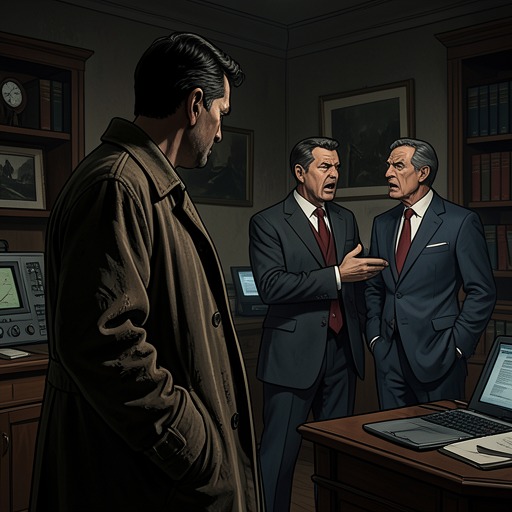
The clearest account of institutional collapse comes in Erath County. When Jefferson Kyle Kidd asks whether a decision against Governor Davis’s supporters is official, a local man explains that there is no local administration, sheriff, justice of the peace, mayor, or board of commissioners. Davis’s government and the United States Army have removed those who served the Confederacy or held public office under it, but no one has been sent to replace them. The speaker’s group has consequently taken on the job of governing and declares Kidd accountable to it. Its authority rests not on an office or an appointment but on its own assertion that it has filled the vacuum.
The exchange makes political change materially ambiguous. The removal of Confederate officeholders does not simply install a stable alternative; it leaves residents subject to ad hoc local power while the Army remains a visible but intermittent presence. The speaker’s claim that the group is entitled to hold travelers accountable turns an administrative absence into an immediate personal risk. Kidd’s careful question about whether the decision is official exposes a central uncertainty of the period: who, in practice, can make a rule binding when the institutions that ordinarily establish and enforce rules have disappeared?
Partisan Conflict in Public
At the Mercantile in Durand, that uncertainty becomes a crowded, combustible performance. A United States Army soldier checks men at the door for handguns, and several weapons are placed on a bench, though the sergeant does not challenge those carrying them. Inside, men and women gather among imported goods beneath swinging kerosene lamps as thunder approaches. Kidd begins with familiar travel news, including the condition of roads and ferries, but the audience is already divided into groups watching one another with suspicion.
The political split breaks into the reading itself. A listener objects to the absence of the Houston Tri-Weekly Union; another dismisses it as a Governor Davis paper and condemns its supporters as unreconstructed thieves. A reply identifies them as Republicans loyal to the Union, only to be answered with an accusation that professional agitators have indoctrinated them. What might have been a communal newspaper performance becomes a contest over who may define loyalty and legitimate public speech. Kidd tries to carry his listeners toward reports of distant places, but a blond man cries that Davis will close the Dallas Courier under the Printing Bill and divert tax money to radical newspapers. The law and the press are not distant abstractions here: they are invoked as evidence that the opposing faction is using government for its own ends.
The quarrel then passes from rhetoric into physical disorder. Two men rise and shout about Hamilton and Davis; people trying to separate them are drawn into the anger. Women leave the building, and some take their male relatives’ handguns from the bench. The Army sergeant hears the shouts about military rule, Austin corruption, and the Printing Bill but stays where he is. Fists and chairs follow; a glass case splinters, money spills from a coin can and is trampled, and a commemorative plate is broken over a man’s head. The scene gives political division a concrete cost: the shared commercial room, its goods, furniture, and money become collateral in a conflict no institution effectively contains.
Kidd’s Work Under Pressure
For Kidd, political disorder also threatens the livelihood that allows him to travel. At the broom and stave mill, where Johanna has been doing domestic work, he selects less provocative reading than he had used in Dallas. His papers include reports on floods in Pennsylvania and railroad bonds in Illinois, alongside British and American periodicals; he avoids material on Hamilton, Governor Davis, Black suffrage in Texas, military occupation, and the Peace Policy. The selection is a practical attempt to soothe an audience and keep political disputes from consuming the performance. Yet the very need to choose news by its capacity to provoke shows how thoroughly public reading has become subject to partisan pressure.
The Mercantile’s riot confirms the danger of remaining in Durand. Although Kidd has collected his fees, local establishments are not open, and seeking .38 ammunition from the proprietor could make him appear to be preparing to shoot someone from the opposing party. He has only eight revolver bullets, along with dove shot, gunpowder, and dimes. He leaves at night, as he had done in Dallas, and gathers Pasha and Fancy from beside the Bosque River near Durand. The choice is not a political declaration but a response to a world in which even buying ammunition may be interpreted as allegiance and intent. Disorder narrows his options before it directly confronts him: earning money, obtaining supplies, and choosing when to depart all require reading local suspicion.
Overlapping Powers on the Road
The countryside beyond the towns offers no simple escape from the political crisis. Kidd’s conversation with Merritt links violence against Mexicans to the same absence of replacement officials: Merritt says Governor Davis dismissed those associated with the Confederacy without appointing successors, while Army personnel appear only sometimes. His account suggests that violence can go unchallenged not because everyone approves of it, but because the authorities who might object are distant or absent. The novel thus connects political disruption in county government to the uneven protection of people beyond its centers.
On the route, military authority is nevertheless visible. About ten mounted infantrymen of the United States Army ride into view, and Kidd hides his revolver before they arrive. He places Johanna in the wagon beneath the wool jorongo and tries to reassure her with gestures of friendship. The soldiers’ approach is a tense encounter with organized authority, but it is distinct from the self-appointed rule of the men in Erath County: the narrative places both within the same journey without making either a dependable solution to its dangers.
Territorial boundaries further complicate that journey. Britt Johnson explains that Johanna’s parents and little sister were killed in a raid, that her relatives Wilhelm and Anna Leonberger provided papers, and that a fifty-dollar gold piece was sent through a major from San Antonio to pay for her return to Castroville. Johnson has promised to bring her out of Indian Territory and across the Red River; the river has risen two feet, and the crossing nearly drowned them. The return mission depends on family instructions, money, an Indian Agent, military and civilian intermediaries, and a dangerous border crossing. Authority and responsibility are distributed across people and jurisdictions rather than secured by one reliable local system.
The landscape itself sustains another form of danger. The Comanche come south from the Red River across the open country around Lampasas, then favor the hill country’s concealment, water, isolated farms, and lack of soldiers. Kidd watches for raiders and prepares to abandon the wagon if necessary, planning to put Johanna on the packhorse and flee. This threat is not identical to partisan conflict, but it intensifies the consequences of weak protection: geography determines where raiding is possible, while the absence of soldiers leaves isolated residents exposed.
The Limits of Legal Repair
Later, in San Antonio, Kidd consults the lawyer Branholme about adoption, returned captives, and the Printing Bill. Branholme says the bill might be rescinded after Governor Davis leaves and the military no longer holds power, suggesting that Kidd’s business could then become feasible again. But his answer about captives is more definite: they belong to their parents or guardians. The conversation places a child’s future and a traveling reader’s livelihood under legal rules that may change with political control, while recognizing that the existing rules still carry force.
This contrast defines the turmoil’s lasting pressure. Political promises of restoration remain conditional on a future change in government, while Kidd must make present decisions amid local intimidation, partisan violence, intermittent military presence, and frontier danger. The novel does not reduce Texas to a single clash between factions: it shows institutions being removed, authority improvised, and law invoked even as its reach proves uneven. In that unsettled space, travel, public speech, and the protection of a child become tests of who can act responsibly when no stable authority can be trusted to do so.